Under Israeli restrictions, Palestinian Christians mark quiet Holy Week
Israeli restrictions disrupt Jerusalem's Holy Week, leaving the Christian Quarter deserted and businesses shuttered.
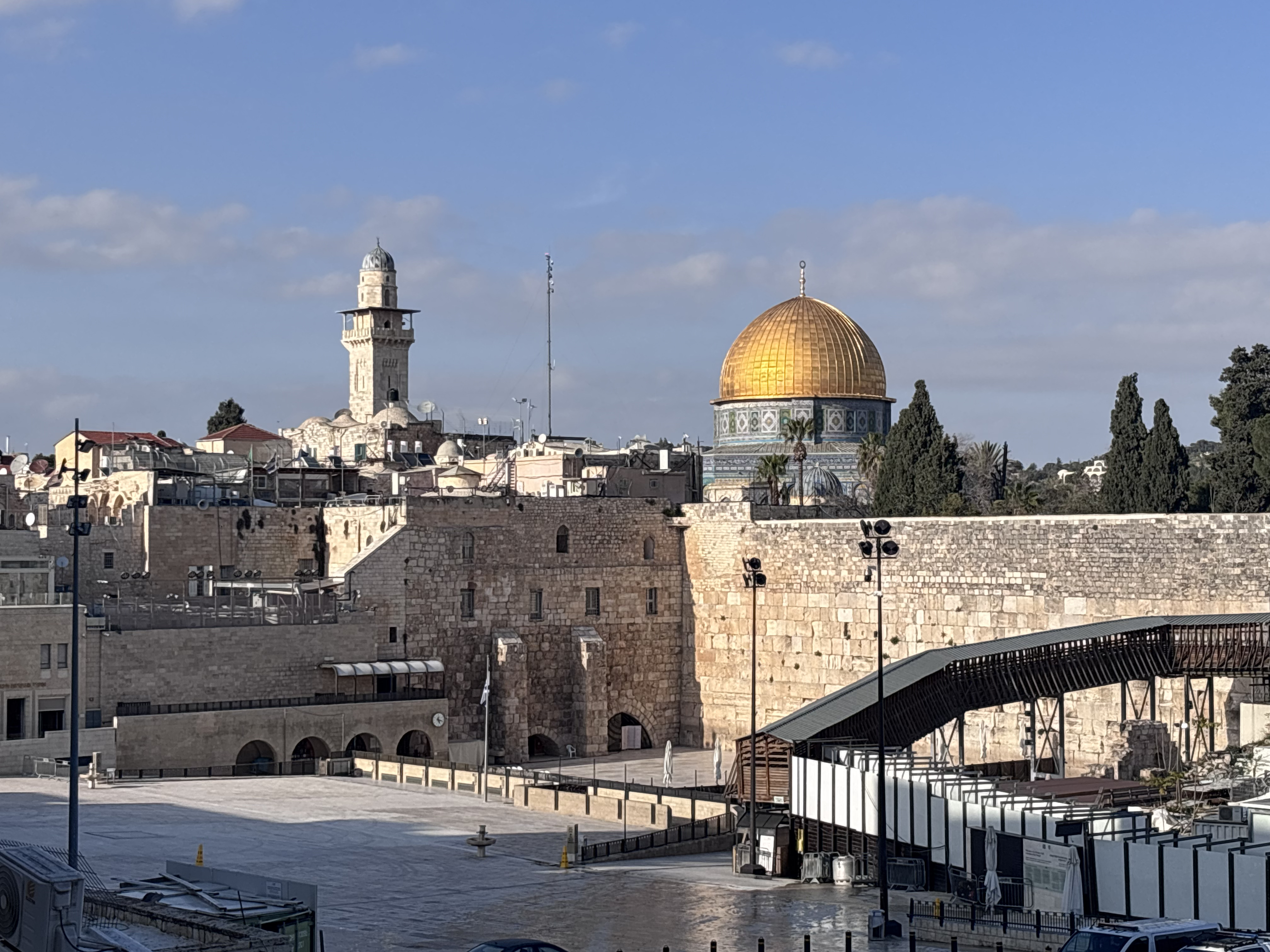
Occupied East Jerusalem – It’s Holy Week for many Christian denominations, marking the week during which Christians believe Jesus was arrested, crucified and resurrected here. And yet, the streets of the Old City’s Christian Quarter are deserted, the shops closed down.
Boulos, a Palestinian Christian man in his mid-30s who did not wish to give his real name, still comes a couple of days a week to his shop, selling religious garments and wares. He keeps the entrance half-shuttered to evade Israeli authorities, who have ordered such shops closed during the ongoing US-Israel war on Iran.
Recommended Stories
list of 3 items- list 1 of 3Monks hold Easter prayers in deserted Old City of Jerusalem
- list 2 of 3How Israel’s record budget will finance expanding illegal settlements
- list 3 of 3Palestinians in West Bank protest, strike against Israeli death penalty law
After six years of severe interruptions to his business in the Old City – starting with the COVID pandemic and continuing with the series of wars since – business had just started to tick up with the return of some international pilgrims following the October ceasefire in Gaza.
“Before the war [with Iran], business was still really bad. But it was at least enough to feed yourself,” said a despondent Boulos. “Now, there’s no business at all, no money at all.”
It was around noon when a local Christian Ethiopian woman came in asking for a kilo of prayer candles, his first customer of the day.
“Since the morning, I’ve been here for nothing,” said Boulos. “What will 35 shekels [$11.20] do for me? What’s the difference?”
While most businesses in Israeli West Jerusalem are now allowed to be open – due to close proximity to bomb shelters – in the Palestinian Old City, where there are no such shelters, local businesses have been mostly forced to close. And it’s the Christian Quarter – heavily reliant on tourism – that shows the least signs of life.
“It is the first time in my life to see Jerusalem as sad as it is,” said Brother Daoud Kassabry, a lifelong Jerusalemite and the principal at the College des Freres School in the Christian Quarter. There have been no in-person classes for more than a month. “This has been the most difficult month in our area here, really, in our time. For parents, for the school, for the students, for the teachers – for everybody.”

‘This country is only meant for them’
Normally, students from Brother Kassabry’s school would join the scouts for the annual Palm Sunday procession. But this year, it was not allowed.
Israeli authorities have gone so far as to bar the Latin Patriarch of Jerusalem, Cardinal Pierbattista Pizzaballa, along with other senior church officials, from entering the Church of the Holy Sepulchre – believed by most Christians to be the site of Jesus’ crucifixion and resurrection, and the holiest site in Christianity – to perform Palm Sunday Mass.
According to the Latin Patriarchate, this was the first time “in centuries” that church officials were unable to do so.
Speaking at a news conference last Tuesday, Cardinal Pizzaballa said “all the celebrations” and gatherings had been cancelled in the past month to abide by military command restrictions. “But there are things that we cannot cancel. No one, not even the pope, has authority to cancel the liturgy of Easter.”
After Israeli police blocked Cardinal Pizzaballa on Palm Sunday, leaders from Italy, France and the United States criticised the actions by Israeli police. Israeli Prime Minister Benjamin Netanyahu subsequently sought to assuage concerns, saying the measures were taken for the cardinal’s “safety” – citing the lack of bomb shelters near the church, despite Pizzaballa living metres away at the Latin Patriarchate.
And as church officials noted, Netanyahu’s implicit assertions of Israeli sovereignty over such properties conflict with the prevailing status quo governing holy Christian and Muslim sites in Jerusalem – which vests control with the heads of churches and the Islamic Waqf, under the custodianship of Jordan’s King Abdullah II.
To local Palestinian Christians, such rhetoric belied the hostile environment they say they endure under Israeli control.
Bishop Emeritus Munib Younan laments the “many times” he has been spat at by Jewish yeshiva students in the Old City without any legal repercussions. Boulos says that when he goes to church, he now chooses the Church of the Nativity in Bethlehem or a small church just outside Jerusalem. “There, nobody is pointing a gun at you on the way to church. Life is at least normal,” he said. “Here, life is not.”
“They [Israelis] want to show the whole world that this country is only meant for them – not Christians, not Muslims,” he said.
The logic of prohibiting a few high church officials from entering the holiest site in Christianity also struck many as hollow.
“In 1967, during the Six-Day War, and I was living in the Christian Quarter, we hid under the Church of St John [the Baptist],” said Bishop Emeritus Younan. “During war, where do you [find] refuge? To church, to the mosque, to the synagogue, to pray and say, ‘God give me strength.'”
Following the backlash from Western Christian allies, Netanyahu said he would allow religious ceremonies at the Church of the Holy Sepulchre during Holy Week, though keeping them off-limits to the general public.
The swift backtracking was seen by locals as a pointed contrast with the ongoing treatment of Muslim worshippers, who have been barred from the Al-Aqsa compound since February 28, including for much of Ramadan.
During Eid, Israeli border police violently dispersed Muslim worshippers attempting to pray outside the Old City walls with tear gas, stun grenades and batons – with little condemnation offered by Western leaders.

‘Steadfastness is not passive endurance’
The restrictions have made it impossible for the dwindling Palestinian Christian community to be able to assert its presence as a unified community in Jerusalem.
School principal Brother Kassabry noted the cancellation of the Way of the Cross procession and Holy Fire Saturday – celebrations specific to Jerusalem. “This year, we miss it,” he said.
From a religious and communal standpoint, the cancellation of these public ceremonies threatens a fragile community whose population has dwindled to less than 2 percent of Israel and the occupied Palestinian territory.
“Many people who don’t enter the church the whole year, they go only on these days, especially on Good Friday,” said Brother Kassabry. “Because this is the feast of Jerusalem.”
Local churches have remained open for services, even though “some people were afraid to come”, Brother Kassabry said.
At local churches, priests like Father Faris Abedrabbo, of the Annunciation Latin Parish in Ein Arik, northwest of East Jerusalem, are weaving these circumstances into their Holy Week messages to congregants. “I tell them … we can recognise in our daily lives something of Christ’s own suffering: his fear, his anguish, his sense of abandonment,” Father Abedrabbo told Al Jazeera. “In this context, one word becomes central for us: steadfastness.
“As Christ himself teaches in the Gospel: ‘By your perseverance you will gain your lives.’”
These developments – especially the total closure of the tourism industry, which the Palestinian Christian community heavily relies on – come as many young Palestinian Christians are actively looking to emigrate.
“Many of the young people tell me, ‘Can you help me get a visa to emigrate to the United States or Canada or Australia?'” said Bishop Emeritus Younan, lamenting their lack of employment opportunities. “I don’t blame them if they think of emigration. But this is bad for our future.”
Boulos, the shopkeeper, admits he’s thought about leaving.
“They try as much as they can to get us to lose hope, and to leave this country,” he said.
For the past five weeks, he says he’s mostly stayed at home, bored. But he still makes the effort to come to the shop a couple of times a week, despite Israeli instructions and having next to no customers.
“I try to have hope. That is why I still come here – to show myself I still have hope,” said Boulos, from inside his lonely shop. “But then, you know it doesn’t stop. It never stops. And they know at some point, you will just give up. You will lose hope.”
Upon such despair, this holy season Father Abedrabbo had a message for his congregation: “Steadfastness is not passive endurance. It is an active, spiritual resistance: to remain rooted in good, in truth … to refuse hatred, and to continue choosing life.”
