Trump welcomes Xi to Washington as US, China agree to extend trade truce
Trump takes rare step of meeting foreign leader at the airport, underscoring the significance of US-China relationship.
China’s Xi visits US as Trump bets on stabilising global relations
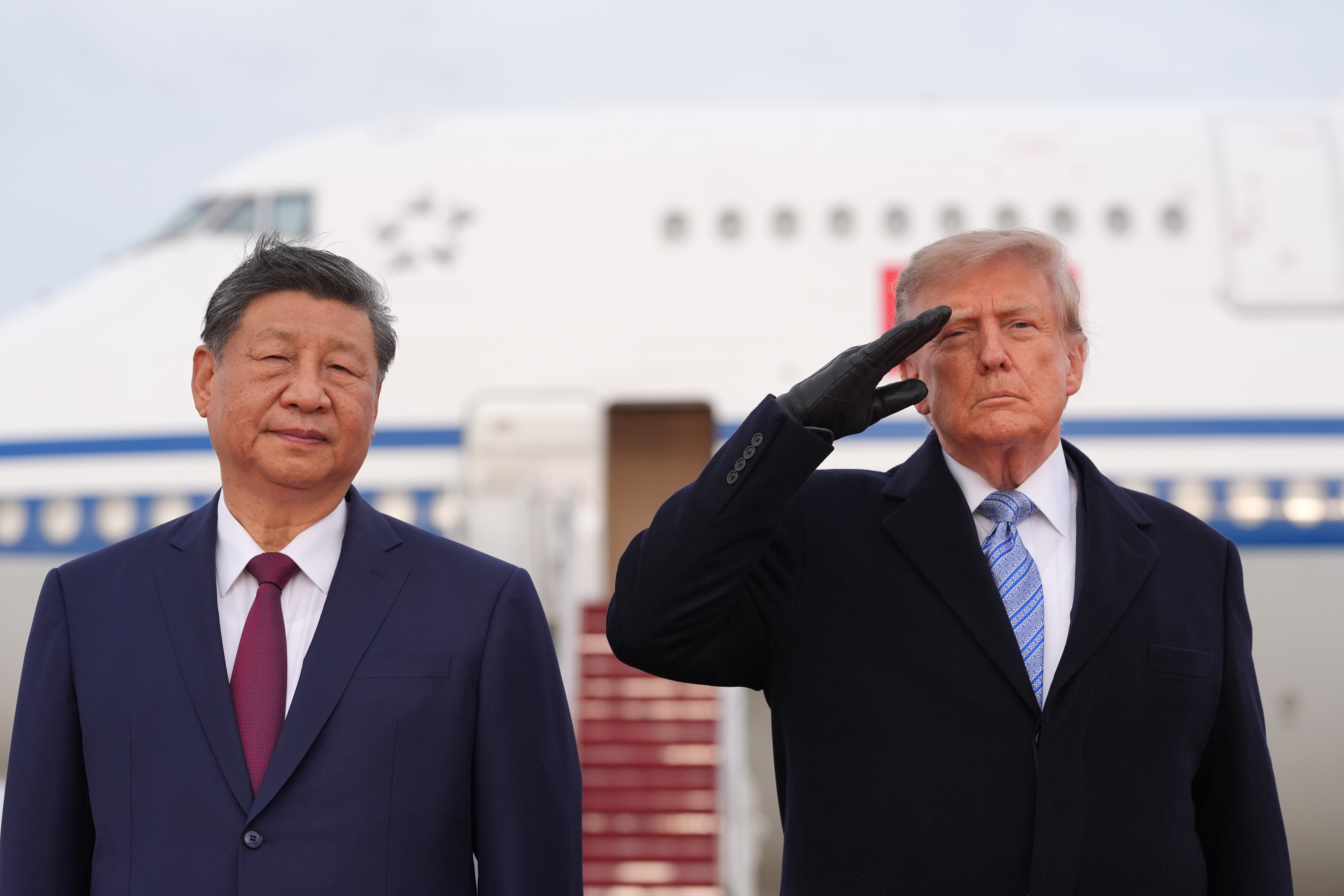
United States President Donald Trump has welcomed his Chinese counterpart Xi Jinping to Washington, DC, for a three-day visit and high-stakes talks on trade, Taiwan and artificial intelligence.
Xi’s landed at Joint Base Andrews, outside the US capital, on Wednesday as the Trump administration announced that the two countries have agreed to extend an 11-month trade deal that offered temporary relief from punishing tariffs.
Recommended Stories
list of 3 items- list 1 of 3As Xi meets Trump, who’s winning their trade war?
- list 2 of 3What’s the US–China AI ‘hotline’ that Trump plans to pitch to Xi Jinping?
- list 3 of 3As AI leaders warn of catastrophe, US and China shun slowdown calls
Trump took the rare step of personally meeting Xi on his arrival, marking the first time in 11 years that a US president has greeted a foreign leader at the base, according to US media.
At the arrival ceremony, the leaders and their wives shook hands, spoke for a few minutes and stood for pictures as a military band played, cannons blasted and a B-1 military bomber flew overhead.
In a written statement afterwards, Xi said China and the US should be partners and not rivals, according to the state-run Xinhua news agency. “He said that the great rejuvenation of the Chinese nation and making America great again can go hand in hand, complement each other and benefit the world,” Xinhua reported.
Trade deal extended
Trump’s in-person greeting signals the significance that Washington ascribes to its relationship with Beijing, whose meteoric economic rise over the last several decades has transformed it into a global superpower capable of rivalling the US.
Xi’s visit comes after he hosted Trump in Beijing in May.
His schedule in Washington, DC, will include a state dinner attended by leaders of the US’s powerful tech industry, a military ceremony at the White House and a visit to the National Archives, home to documents of historical and cultural significance such as the US Constitution and the Declaration of Independence.
His talks with Trump are likely to cover the US-Israel war on Iran, the US-China trade deal, AI, and US ties to Taiwan, the self-governing island that China claims as part of its territory, according to analysts.
US Treasury Secretary Scott Bessent told Fox News on Wednesday that he had met with Chinese Vice Premier He Lifeng ahead of Xi’s visit to “see if we could do a bigger deal as opposed to just a series of smaller things”.
“We have agreed today that we will extend what we call the Busan Agreement,” Bessent said.
The agreement, which was set to expire on November 10, has now been extended to January 10, he said.
‘Unprecedented’ visit
Yun Sun, a senior fellow and director of the China Program at the Stimson Center, said the short extension suggests the two nations were planning a wider deal.
“The two sides indeed have a bigger scope of negotiation coming to their trade deals, and they need more time to negotiate the technicalities,” she told Al Jazeera, adding that the truce was expected to hold even before the trip began.
Sun called Xi’s visit to the US “unprecedented”, saying “there has never been any precedent in the history of US-China relations for the top two leaders of the two countries to visit each other within a single year”. She described the stabilisation of ties as “quite prominent and very impressive”, noting that only 12 months ago, the two countries were escalating tariffs and export controls against each other.
On Taiwan, Sun said Beijing’s main goal would be to prevent or stall a $14bn arms package that Congress approved earlier this year, but the Trump administration has been unwilling to advance.
She said she expected the most progress on AI, where the two governments could agree on ways to manage their dialogue.
“We know that the US has proposed a hotline mechanism for notification to each other when there is a significant security risk associated with AI that happens in their individual country,” she said. “We’ll have to see whether the two leaders are able to make progress on this important issue.”
