Thousands stranded as Anak Krakatau eruption shutters Indonesian airports
A total of 1,558 flights have been delayed or cancelled across the eight affected airports, including more than 900 to and from the country’s main Soekarno-Hatta airport.
![Stranded passengers wait at the check-in area as Soekarno-Hatta International Airport near Jakarta, Indonesia, on September 6, 2026 [Ajeng Dinar Ulfiana/Reuters]](/wp-content/uploads/2026/09/2026-09-06T032843Z_1587164556_RC2FDNACHP90_RTRMADP_3_INDONESIA-VOLCANO-1788723902.jpg?resize=770%2C513&quality=80)

Indonesia’s main international airport outside Jakarta and three others delayed reopening on Monday, after volcanic ash from the erupting Mount Anak Krakatau spread across the capital.
Eight airports, including Soekarno-Hatta International, halted operations over the weekend after ash was detected in their airspace, disrupting thousands of flights and leaving more than 270,000 passengers stranded, the Transport Ministry reported on Monday.
Recommended Stories
list of 3 items- list 1 of 3‘Everything is covered in ash’: Indonesia wildfires leave people in crisis
- list 2 of 3Indonesia sets up shelters for babies, children affected by wildfire smoke
- list 3 of 3Toxic haze from Indonesian forest fires chokes Malaysian Borneo
“These figures are the cumulative operational impact since 5 September 2026 and cover flights that have been canceled, delayed, or diverted,” the ministry said in a statement.
The four airports extended their closure from Monday morning to 6:00pm local time (1100 GMT), airport operator Angkasa Pura said in a social media post.
A small airport in South Sumatra resumed flights on Monday morning at 9:00 am local time, the Transport Ministry said.
More than 240 domestic and international flights were cancelled or delayed due to the volcanic ash on Monday morning alone, Jakarta’s Soekarno-Hatta international airport said, adding that nearly 30,000 passengers were affected.
“We understand that this situation affects passengers’ travel plans. Therefore, from the start of the temporary closure, we have focused on ensuring that passengers’ needs continue to be met,” the airport’s spokesman, Yudhistiawan, who like many Indonesians has only one name, said in a statement.
The probability of an eruption remained high until Monday morning, the country’s geology agency warned.
Several airports in cities, including Semarang and Surabaya, have been prepared as “alternatives for landing”, the country’s Transportation Minister Dudy Purwagandhi said on Sunday.
Across Jakarta, schools are closed as classes move online, the city said in a statement, without specifying how long the measure would be in place.
Anak Krakatau, which began erupting late on Friday, produced a fountain of lava and booming sounds that could be heard up to 700km (435 miles) away, according to Indonesian authorities.
Ash was identified as high as 6,000 metres (20,000 feet) on the Java side of the volcano, and a plume of up to 15,000 metres (50,000 ft) on the Sumatra side and in some parts of Banten province in Java, the meteorological agency BMKG posted on its website.
Two new eruptions were recorded on Sunday, BMKG said.
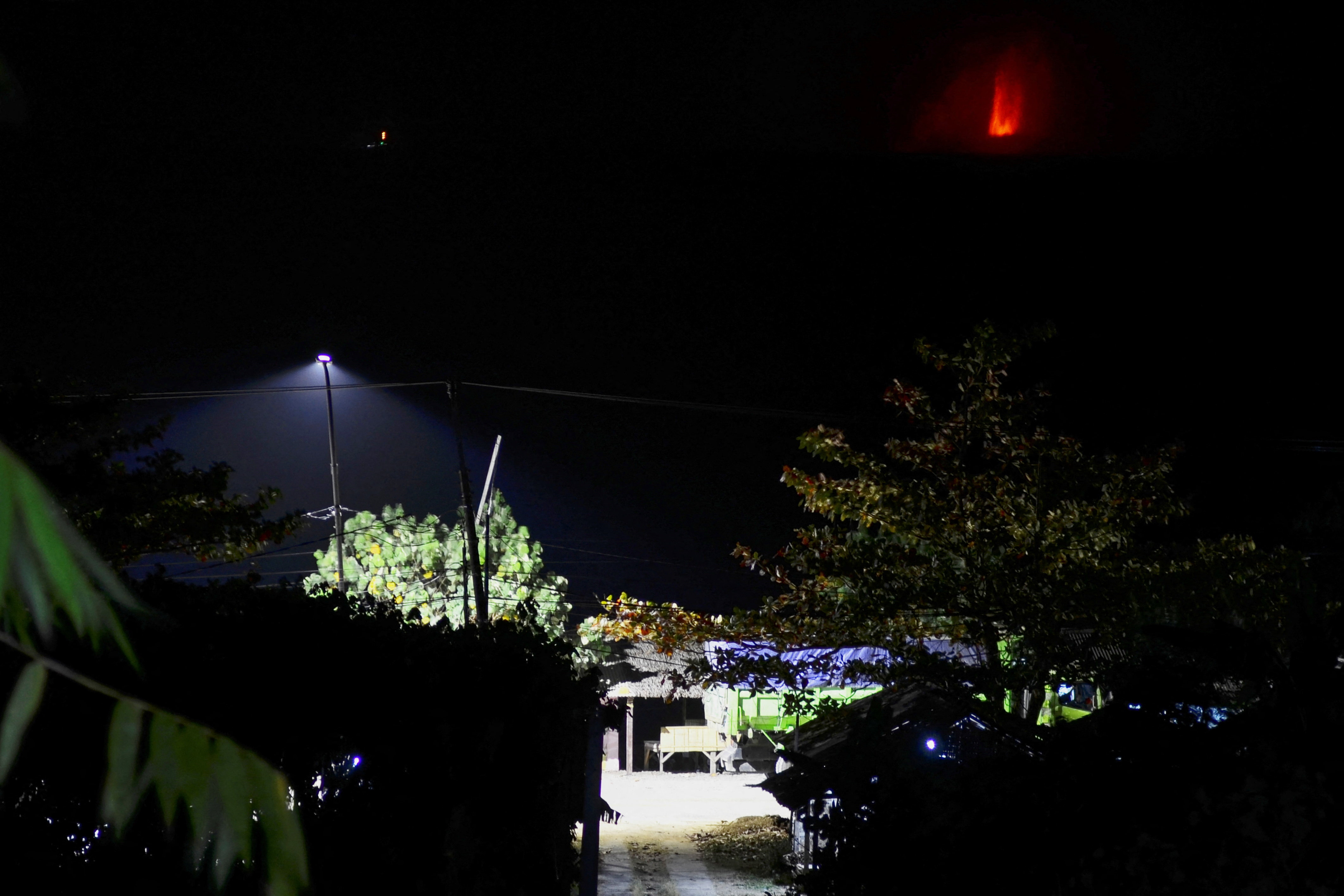
Indonesia’s disaster mitigation agency, BNPB, said that there was no imminent tsunami risk from the eruption, and announced on Sunday that it would take measures, such as cloud-seeding, to encourage rain to wash away the ash.
“If it rains heavily enough, the volcanic ash that has been disrupting our daily lives since yesterday and continuing today will be washed away quickly,” BNPB chief Suharyanto told a news conference.
Anak Krakatau emerged from the sea in the 1920s in the caldera left by the catastrophic 1883 eruption of Krakatoa, one of the deadliest volcanic events in recorded history.
It sits in a strait that separates the islands of Java and Sumatra.
Ships passing through the strait were asked to increase vigilance for possible disruption to navigation safety due to volcanic activities.
Vessels are prohibited from approaching an exclusion zone of a three-kilometre radius from the volcano, local port authorities said in a statement.
The volcano erupts periodically, including a 2018 eruption that triggered a partial collapse of its crater and a tsunami that killed more than 400 people along the coasts of Java and Sumatra.
Volcanic ash poses a serious hazard to aircraft, capable of damaging jet engines and reducing visibility.
